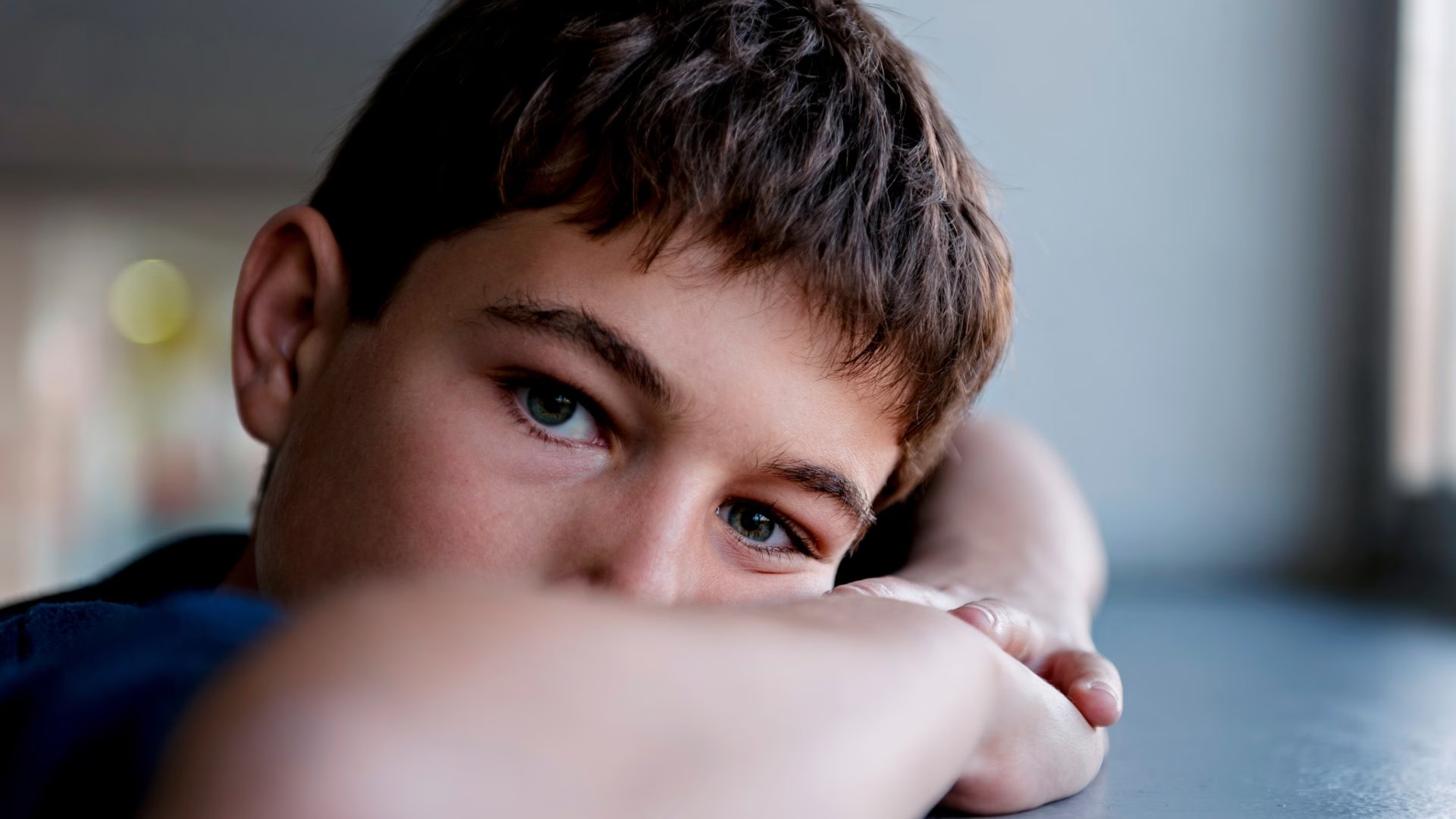
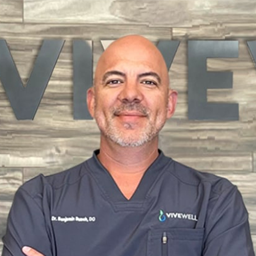


Dr. Dana Johnson, the Spellers Centers, and what it means to care for the whole child
Your child reaches for your hand when they want to leave. They light up at a familiar song. You may notice changes in their expressions or movements, even when you are unsure what those changes mean.
When speaking is difficult or unreliable, families learn to pay attention to all of it. They also wonder what else their child might want to share, and whether they have found the right ways to help.
That question is at the heart of Dr. Dana Johnson’s work with the Spellers Centers. It is also one we care about at ViveWell. Children need people who will keep listening, keep asking questions, and look at their health and communication together.
A Look Inside the Spellers Centers
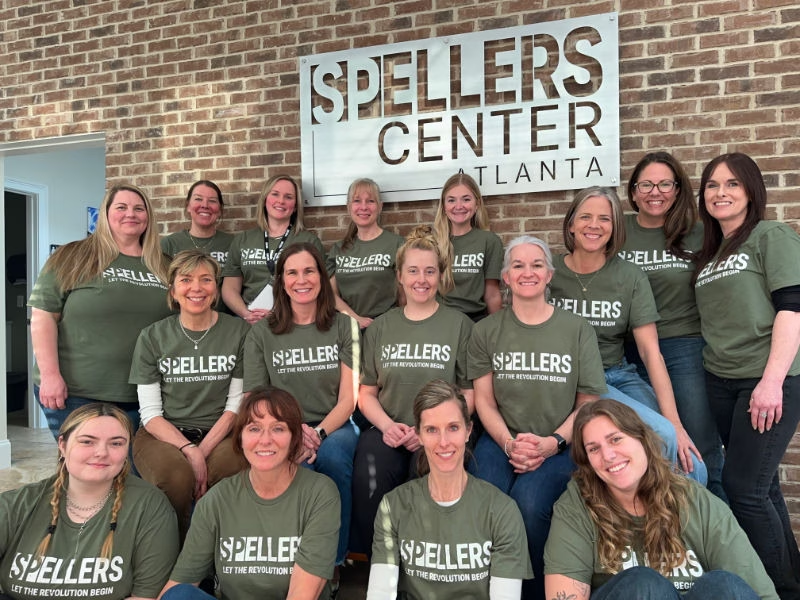
The Spellers Centers work with nonspeaking people who are learning to spell or type. Their Spellers Method™ brings together lessons, movement practice, attention to visual and motor skills, and coaching for the person helping with the letterboard or keyboard. The centers also offer opportunities to learn alongside others and spend time together socially. Spellers currently lists centers in Tampa, Atlanta, and Charleston; the Tampa center also offers occupational therapy and programs focused on purposeful movement. [1]
For a family who has tried many things, the idea of another possible way to communicate can be deeply meaningful. It is reasonable to be hopeful. It is just as reasonable to ask how the approach works for your child, what progress would look like, and how it would fit with the tools they already use.
The Movement Behind the Message
Dr. Johnson is an occupational therapist with a PhD in infant and early childhood mental health and development. She co-created the Spellers Method and founded the Tampa and Atlanta centers. A thread through her work is the idea that a child may need support with the movements involved in speaking, pointing, or typing. [2]
Think about how much has to happen before someone can point to a letter: notice it, plan the movement, reach for it, and repeat that sequence. For some children, those steps may be harder than they appear from the outside. That does not tell us what any one child understands. It gives us a reason to take their motor needs seriously and assess them individually.
Researchers studying 54 low- or minimally verbal autistic people found signs of motor speech difficulties in that group. The study cannot tell us that every nonspeaking child has apraxia, but it helps explain why speech and motor skills deserve a closer look. [3]
Dr. Johnson’s team also talks about listening to parents and caregivers. That matters. A parent may notice how their child communicates at breakfast, in the car, or after a difficult night’s sleep, moments a clinician will never see in a single appointment. [1]
Bringing the Conversation to the Screen
Imagine spending years wondering what your child is thinking. You learn to read expressions, notice patterns, and make your best guesses. Still, you wonder about the things a glance cannot tell you: their opinions, their observations, what they find funny.
Then imagine discovering that your child has a sharp, wonderfully witty sense of humor. Suddenly, there is a whole new kind of conversation to have. You want to hear the next funny observation. You want to know what else they have to say.
That possibility is at the heart of the Spellers film. The documentary asks parents, educators, and therapists to begin with the belief that nonspeaking people can think, learn, and understand. It’s called “presuming competence” and challenges viewers to reconsider the expectations they may have attached to someone’s ability to speak. Through the experiences of its participants, the film explores what can happen when people are given opportunities to express more of themselves.[4, 5, 6]
The film shows Spelling to Communicate (S2C), alongside the work associated with the Spellers Method, which emphasizes purposeful movement and visual coordination in learning to use letterboards and working toward independent typing. The emotional moments it presents reach beyond the letters themselves: families describe discovering more of their loved ones’ thoughts and personalities, while nonspeaking people are portrayed sharing ideas and hopes for their lives. Those stories also challenge schools and traditional therapy approaches to ask whether their expectations have left enough room for learning, meaningful participation, and a person’s own ambitions.[1, 4, 6]
For anyone curious about the people and experiences behind this work, watching Spellers offers a personal introduction. Its stories can open a conversation; understanding the research helps us carry that conversation forward.
Making Space for Possibility and Proof
There is a genuine scientific debate about spelling approaches that rely on another person to hold a letterboard or provide prompts. The American Speech-Language-Hearing Association (ASHA) advises against Rapid Prompting Method and related facilitator-dependent approaches, including methods called Spelling to Communicate. Its concern is that the scientific evidence has not established whether assisted messages consistently come from the person spelling rather than being influenced by the communication partner. [7]
There is research adding to the discussion. In one eye-tracking study, nine experienced nonspeaking letterboard users looked at letters before pointing to them in patterns the researchers interpreted as evidence of their own letter choices. The authors were careful about the limits: these were experienced users, and the study does not show that the approach works for everyone or resolve every question about assisted messages. [8]
Families should be able to hear both of those things without feeling pushed to choose a side. Whatever they decide to explore, their child should have access to an individualized communication assessment and other options that can be used across daily life. These may include gestures, pictures, independently used letterboards, and speech-generating devices. Pediatric and speech-language guidance calls for a team approach that includes the child and family. [9, 10]
What ViveWell’s Whole-Child Care Adds to the Conversation
Sometimes a child is working hard to communicate while also dealing with poor sleep, stomach pain, feeding difficulties, or another health concern. Those experiences deserve attention in their own right. Pediatric guidance recommends identifying medical conditions that occur alongside autism, and a longitudinal study found that gastrointestinal symptoms in autistic children were associated with sleep and other difficulties. That does not mean one caused the other, or that treating a health concern will change a child’s communication. It means we should take the concern seriously when a family brings it up. [11, 12]
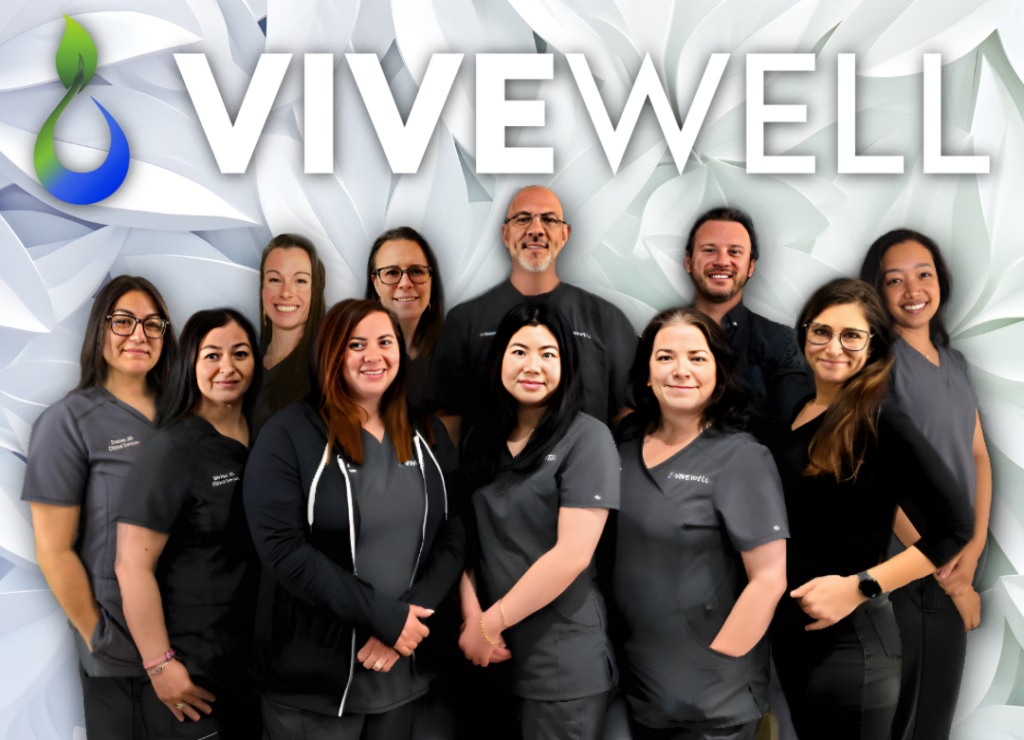
This is where ViveWell’s Complex Pediatric Care may fit. We start by hearing the family’s story and reviewing the child’s health history, symptoms, and day-to-day challenges. When a medical concern calls for further evaluation, our clinicians work with the family on an individual plan.
That care can happen alongside occupational therapy, speech-language support, school services, and whichever communication tools help the child participate. [13]
If a family tells us they are exploring a Spellers Center, we want to know what they have learned about their child in the process. What helps them feel comfortable? How do they let people know when they need a break? What have their therapists and teachers noticed? With the family’s permission, those observations can make medical visits more responsive to the child in front of us.
ViveWell shares Dr. Johnson’s thoughts on that larger picture. Her focus on movement and on taking families seriously offers a meaningful starting point for a conversation between communication professionals and pediatric clinicians.
Keep Listening. Keep Learning.
There may be more than one helpful way for a child to be heard. Families deserve room to explore those possibilities, ask hard questions, and get thoughtful care for health concerns that matter to their child’s everyday life.
You can learn about Dr. Johnson’s programs through the Spellers Centers. If you would like to talk about your child’s health and whether ViveWell’s Complex Pediatric Care may be a fit, book a free Health Discovery Session or call (303) 565-8483.
This article is educational and does not replace individual medical or communication advice. ViveWell and the Spellers Centers are separate organizations. Families should make care and communication decisions with qualified professionals who know their child.
Professional References for Editorial Review
- Spellers. Spellers Centers, Spellers Method, and Spellers Center Tampa.
- Johnson, Dana, PhD, MS, OTR/L. About Dana.
- Maffei, M. F., et al. (2024). Exploring Motor Speech Disorders in Low and Minimally Verbal Autistic Individuals: An Auditory-Perceptual Analysis. American Journal of Speech-Language Pathology. doi:10.1044/2024_AJSLP-23-00237.
- Spellers Freedom Foundation. Spellers the Movie.
- Spellers Freedom Foundation. Get Started.
- Jusino, Ann. Spellers The Movie Review. CrimsonRise.
- American Speech-Language-Hearing Association. (2018). Rapid Prompting Method: Position Statement.
- Jaswal, V. K., Wayne, A., & Golino, H. (2020). Eye-tracking reveals agency in assisted autistic communication. Scientific Reports, 10, 7882. doi:10.1038/s41598-020-64553-9.
- American Academy of Pediatrics. (2025). Prescribing Assistive Technology: Focus on Children With Complex Communication Needs: Clinical Report. Pediatrics, 156(1), e2025072216. doi:10.1542/peds.2025-072216.
- American Speech-Language-Hearing Association. Augmentative and Alternative Communication (AAC). ASHA Practice Portal.
- Restrepo, B., et al. (2025). A longitudinal evaluation of gastrointestinal symptoms in children with autism spectrum disorder. Autism, 29(11), 2832–2845. doi:10.1177/13623613251362349.
- Hyman, S. L., Levy, S. E., & Myers, S. M. (2020). Identification, Evaluation, and Management of Children With Autism Spectrum Disorder. Pediatrics, 145(1), e20193447. doi:10.1542/peds.2019-3447.
- ViveWell Health. Complex Pediatric Care.